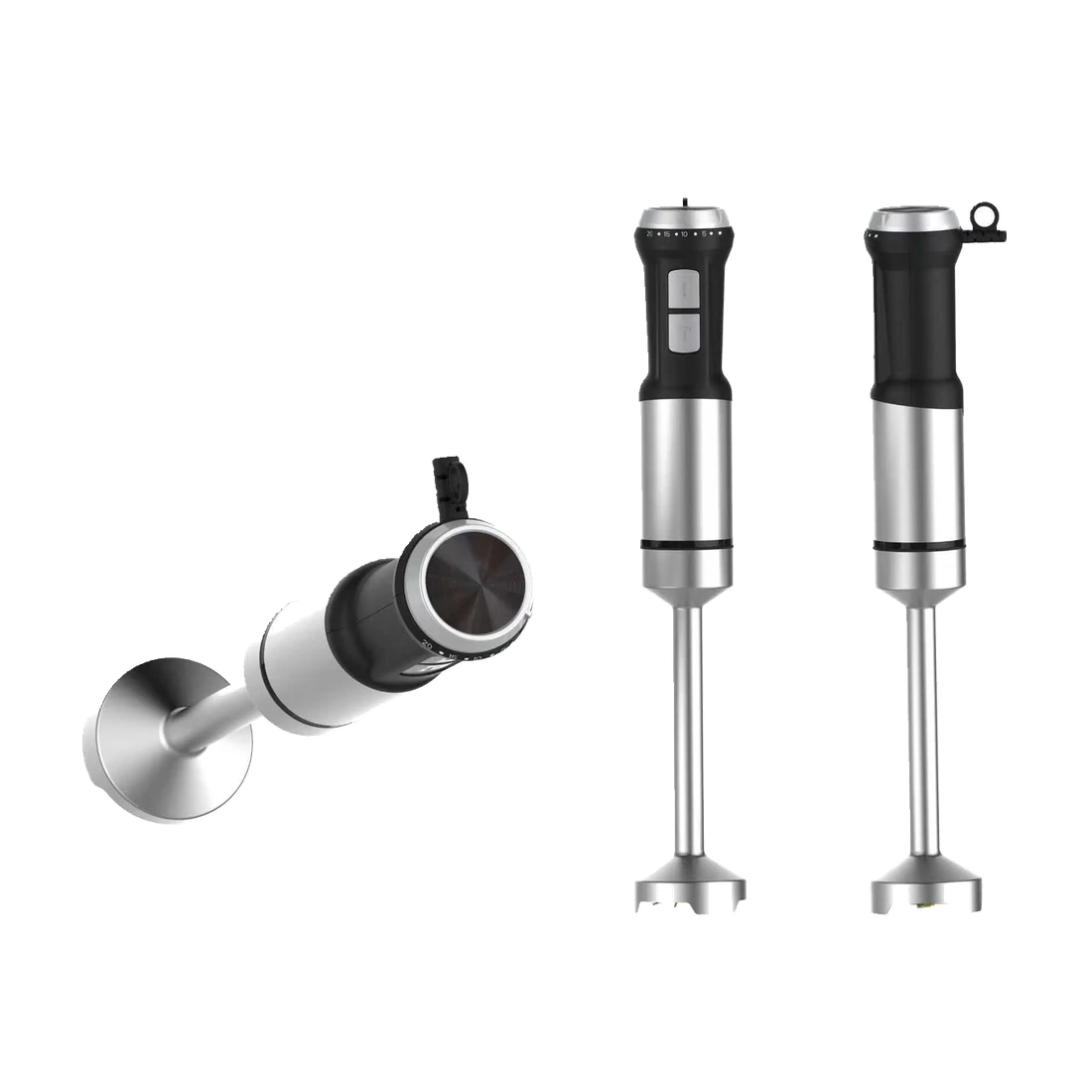
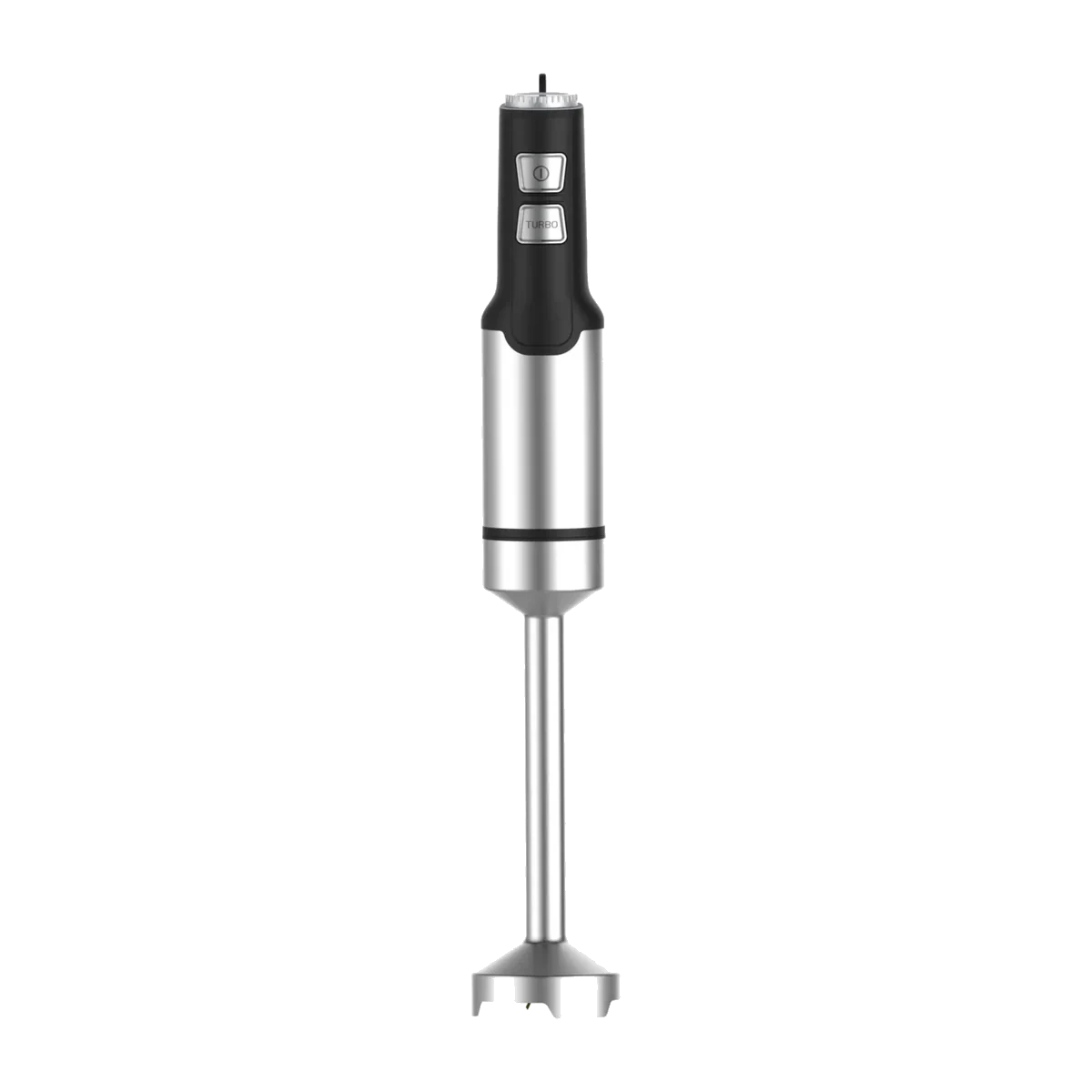
Hand blender OEM programmes from entry models to premium sets
An immersion blender line usually has to serve several price points from the same engineering base. Golden-Yee structures the category that way: a lightweight detachable model for opening price points, a mid-range version with two-speed thumb control and a stainless-steel shaft, and higher-power dial-control models with adjustable speed for buyers positioning the product as a kitchen tool rather than an accessory. Set versions add a whisk, chopping bowl, beaker and accessory stand so the product can be sold as a preparation kit. Because the motor body, shaft interface and control architecture are shared across the family, a buyer can plan a stepped range without funding separate tooling for every SKU.
- Lightweight detachable hand blenders for entry and promotional price points
- Two-speed thumb-control models with detachable stainless-steel shafts
- Dial-control immersion blenders with adjustable speed for premium positioning
- Complete preparation sets with whisk, chopping bowl, beaker and accessory stand
Motor and shaft configurations for immersion blenders
Motor class is the single biggest driver of product positioning and cost in this category. The range covers lightweight bodies for simple blending tasks and higher-power versions for tougher ingredients and continuous use, with motor output options selected according to the job the product is sold to do. Shaft design follows the same logic: a slim stainless-steel shaft is the default for retail-positioned models, detachable shafts make cleaning easier and support product claims around hygiene, and shaft geometry affects how the blade assembly performs in a pot or a beaker. Button layout, grip shape and body length are confirmed at the same stage, because they determine how the blender feels in use and how it is photographed and described on packaging.
- Motor output options across the range, from lightweight to high-power bodies
- Detachable stainless-steel shafts for cleaning and premium positioning
- Blade assembly and shaft geometry matched to the intended blending use
- Grip shape, body length and button placement confirmed with the sample
Control styles: two-speed, dial and variable speed
Control design separates a basic hand blender from a premium one more clearly than almost any other feature, and it is also one of the easiest points for a private label to differentiate. Two-speed thumb controls give a predictable, low-cost interface that shoppers understand immediately. A top-mounted speed dial signals a more capable product and supports variable-speed claims, and models with decorative dial finishes or illuminated detailing give the brand a visual hook for packaging. Illuminated operating rings and marked speed scales can be specified on selected platforms where the buyer wants the product to look distinctive on shelf, and the control feel is validated in the sample stage.
- Two-speed thumb control for straightforward, low-cost interfaces
- Top-mounted adjustable dial with variable-speed positioning
- Decorative dial finishes and illuminated operating rings on selected models
- Speed graphics, button finish and control feel confirmed at sample stage
Accessory planning and retail bundles
Accessories turn a single blender into a set, and for many buyers the set is the product: a higher retail price, more shelf presence and a clearer gift or starter-kit message. The common configuration combines the blending shaft with a whisk for cream and egg whites, a chopping bowl for onion and herbs, a beaker for blending in quantity, and a stand or wall bracket for storage. Accessory mix is planned around the retail position rather than added at the end, because each attachment affects packaging depth, carton quantity, instruction content and the safety information printed on the label. For buyers who need one product to carry a range rather than several SKUs, accessories are the most flexible tool available.
- Whisk, chopping bowl and beaker configurations for set packaging
- Storage stand, wall bracket and accessory holder options
- Bowl capacity, blade type and lid design matched to the accessory mix
- Carton depth, unit weight and packing quantity planned with the set
Voltage, plug and compliance for hand blender projects
Immersion blenders are sold across regions with different electrical standards, so the electrical specification is planned per destination market. The same platform can be produced for 110 to 120 V markets and 220 to 240 V markets with the corresponding frequency, plug type, cord length and rating label. Compliance follows the market and the channel: European programmes commonly work to CE and UKCA, North American programmes to UL or ETL listings, and other regions to their own national schemes. Instruction manual language, warning text, immersion-use and cleaning instructions, and the marking on the motor body are prepared together so the product and its documentation describe the same specification.
- 110 to 120 V and 220 to 240 V builds with matched plug and cord
- CE, UKCA, UL or ETL and other national schemes planned per project
- Rating label, marking and manual language prepared with the product
- Immersion-use, cleaning and warning instructions aligned to the market
Tooling, samples and packaging for hand blender OEM work
Hand blender projects usually move from platform selection to sample, then to pre-production approval and production. Samples are used to confirm blending performance, noise, shaft fit and control feel, and to check appearance against the intended market. Because much of the differentiation in this category sits in colour, trim, dial finish, shaft and accessories, a brand-specific product can often be built without new tooling, which keeps the investment proportionate to the expected volume. Packaging is planned in parallel: retail cartons, gift sets, master carton artwork, carton marking and loading quantity for shipment from Ningbo, so the product, the presentation and the freight plan are finalised together rather than in sequence.
- Sample builds for performance, noise, shaft fit and appearance approval
- Colour, trim, dial and shaft changes without new tooling where possible
- Retail carton, gift set and master carton artwork configuration
- Carton marking, loading quantity and shipment planning from Ningbo